


Porsche Cayenne Maintenance Guide: By Generation, By Interval
The Cayenne is one of the more demanding Porsches to maintain well; not because the car is unreliable, but because it’s complex. Three distinct generations across 20+ years, multiple powertrain configurations, available air suspension, PDK and Tiptronic transmission variants, and now a full E-Hybrid lineup that introduces high-voltage systems to the equation. Each generation has its own service schedule and its own documented vulnerabilities.
This guide covers the Cayenne as it actually exists in the real world: by generation, by service milestone, and by the specific issues our technicians see most often on each platform. Whether you’re servicing a 955 Turbo, a 958 S E-Hybrid, or a current 9YA GTS, the intervals and watchpoints are different enough to warrant knowing which one you’re dealing with.
For a full breakdown of what Cayenne maintenance costs relative to other Porsche models, see the Porsche Maintenance Costs Guide. This page focuses on what to do and when, and what tends to go wrong if you don’t.
Cayenne Generations at a Glance
| Generation | Years | Code | Engine Options | Transmission |
|---|---|---|---|---|
| First Generation | 2003–2010 | 955 / 957 | V6, V8, V8 Turbo | Tiptronic |
| Second Generation | 2011–2018 | 958 | V6, V8, V8 Turbo, Diesel, S Hybrid, S E-Hybrid | Tiptronic / PDK (2015+) |
| Third Generation | 2019–Present | 9YA | V6, V6 Turbo, E-Hybrid, Turbo, Turbo GT, Turbo S E-Hybrid | PDK (8-speed) |
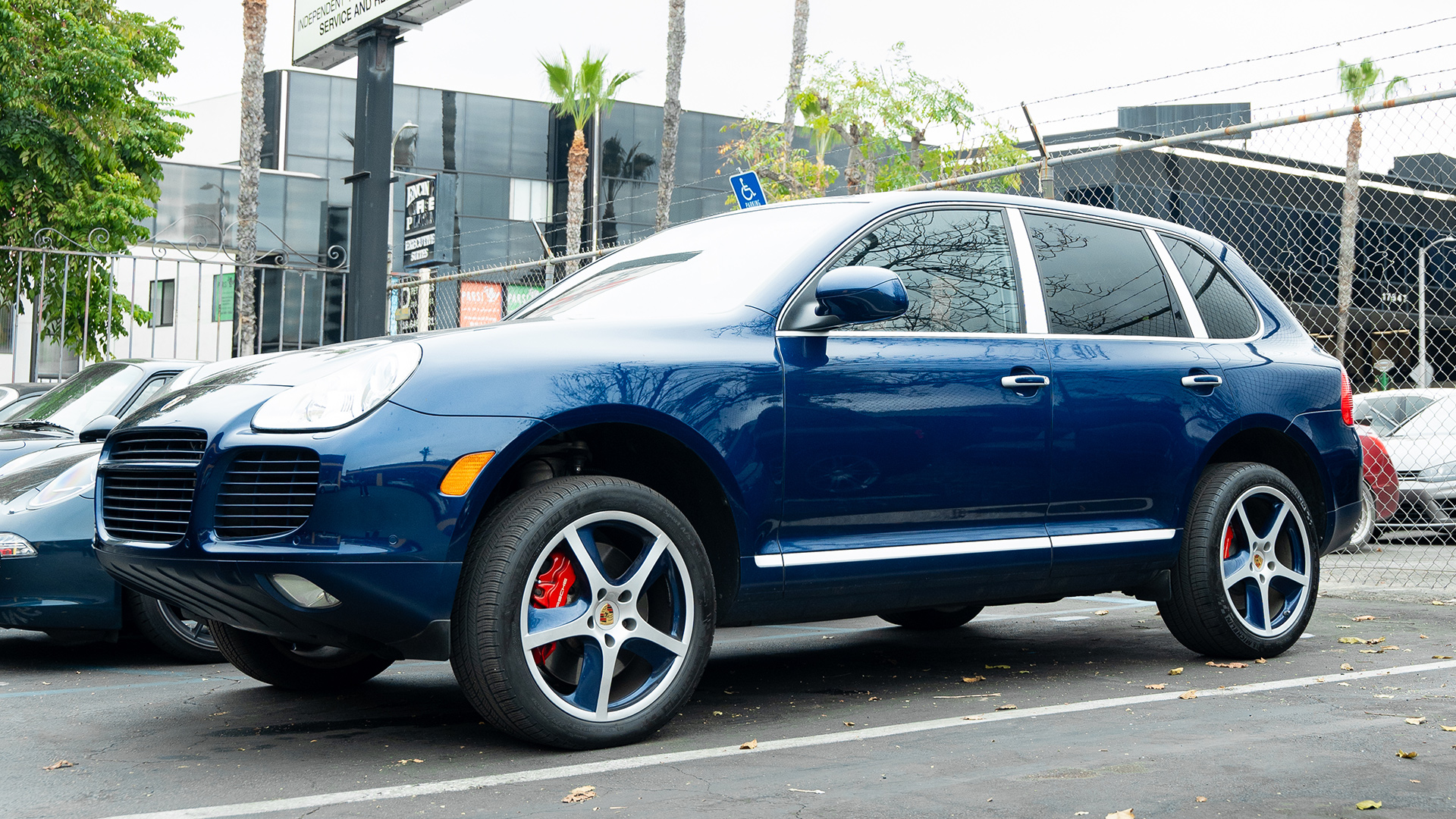
First Generation: 955 & 957 (2003–2010)
Service Schedule
| Service | Interval |
|---|---|
| Oil and filter change | Every 10,000 miles or 1 year |
| Brake fluid replacement | Every 2 years |
| Spark plug replacement | Every 20,000 miles (V6) / 30,000 miles (V8) |
| Air filter replacement | Every 20,000 miles or as needed |
| Transmission fluid (Tiptronic) | Every 30,000–40,000 miles |
| Transfer case fluid | Every 30,000–40,000 miles |
| Differential fluid | Every 40,000 miles |
| Coolant system inspection | Every 20,000 miles — especially on V8 models |
Technician note: Earlier 955 models (2003–2006) were often run on shorter oil intervals by previous owners given the era’s conventions. If you’re buying a used 955 and the service history shows variable intervals, a PIWIS scan and a fresh oil analysis will tell you more than the odometer will.
Common Issues to Watch For
Coolant pipe failure (V8 — critical). This is the most significant preventive maintenance item on the 4.5L V8 955. The factory coolant pipes are plastic and run beneath the intake manifold. Heat cycling over time makes them brittle, and when they crack, coolant can drain rapidly. The repair requires intake manifold removal, and most shops use the job as an opportunity to replace the water pump and thermostat at the same time — the teardown cost is already accounted for. If your 955 Turbo or S hasn’t had this done and is over 80,000 miles, treat it as a near-term maintenance item, not a speculative repair.
Coolant expansion tank cracks. Separate from the coolant pipe issue, the expansion tank itself is another known failure point on the 955/957. Owners often notice a coolant warning light without a visible external leak — the tank is losing pressure internally. A PIWIS scan combined with a visual inspection will catch this early.
Transfer case wear. Transfer case wear was documented across all three Cayenne generations, but the 955/957 Tiptronic-equipped cars are particularly sensitive to fluid condition. Regular fluid changes at the intervals above are the best preventive measure. Symptoms of wear include vibration during acceleration and a skip or shudder at full steering lock.
Air suspension compressor. The Cayenne’s optional air suspension compressor is a known wear item. Compressor failure results in a gradual suspension collapse as the system can’t maintain pressure. The failure mode is often slow — a car that sits overnight and is noticeably lower in one corner the next morning is a classic early signal. The air suspension relay can also fail and mimic compressor failure, so proper diagnosis before replacement matters.
Second Generation: 958 (2011–2018)
The 718 platform is generally considered among the most cost-effective Porsches to maintain, with average annual repair costs around $952–$1,135; relatively modest for the segment.
Service Schedule
| Service | Interval |
|---|---|
| Oil and filter change | Every 10,000 miles or 1 year |
| Brake fluid replacement | Every 2 years |
| Intermediate service | Every 20,000 miles or 2 years |
| Spark plug replacement (V6 / S E-Hybrid) | Every 40,000 miles or 4 years |
| Spark plug replacement (S / Turbo) | Every 30,000 miles or 4 years |
| Major service | Every 40,000 miles or 4 years |
| PDCC reservoir replacement | Every 60,000 miles or 6 years |
| Air filter replacement | Every 80,000 miles or 4 years |
| Transfer case fluid | Every 20,000 miles — see note below |
| Differential and transmission fluid | Every 60,000 miles |
Transfer case note: Standard Porsche factory intervals put transfer case fluid at longer intervals, but given the well-documented transfer case issues on the 958 (detailed below), HOUSE Automotive recommends pairing transfer case fluid changes with every intermediate service at 20,000 miles. The cost of the fluid change is negligible next to a transfer case replacement.
958 S Hybrid & S E-Hybrid Additions
The 958 introduced Porsche’s first production hybrid Cayenne — the S Hybrid (2011–2014) and S E-Hybrid (2015–2018). These require a few additional service items beyond the standard schedule:
| Additional Service | Interval |
|---|---|
| Charging port tray water drain hose inspection | Every 20,000 miles / 2 years |
| Clutch brake fluid change and adaptation (S E-Hybrid) | Every 40,000 miles / 4 years |
| Supercharger drive belt replacement (S E-Hybrid) | Every 60,000 miles / 6 years |
| High-voltage battery inspection | Every service visit — PIWIS required |
See the dedicated E-Hybrid & High-Voltage Battery Care section below for full charging and battery maintenance guidelines.
Common Issues to Watch
Transfer case failure. The 958 transfer case is one of the most documented failure points in any Porsche SUV. The internal clutch packs in early production units used materials that accelerate wear, and degraded fluid compounds the issue significantly. Symptoms include shuddering under acceleration, a jumping feeling at full lock, and AWD warning lights. Porsche extended its warranty coverage on the transfer case across multiple model years — a formal acknowledgment of the issue’s scope. A proactive fluid change schedule significantly reduces the risk. If you’re buying a used 958, transfer case condition should be on every pre-purchase inspection checklist.
Coolant pipe failure on V8 models (4.8L). Like the 955, the 958 equipped with the 4.8L V8 shares a related coolant system vulnerability. The factory coolant pipes are bonded into the coolant housing with an adhesive that heat cycles and engine vibration degrade over time. Sudden coolant loss from a failed pipe-to-housing bond is an abrupt failure mode — there’s rarely a gradual warning. On high-mileage 958 V8 cars, this should be inspected proactively, ideally around the 80,000–100,000 mile mark.
Air suspension compressor and air strut leaks. The 958 saw the same air suspension compressor wear patterns as the 955, with additional reports of air strut leaks developing around the 80,000–100,000 mile threshold on cars equipped with PASM air suspension. A car that sits low on one corner after overnight parking, or one that throws a chassis system error, warrants a proper suspension system inspection before the issue cascades into compressor failure.
High-voltage battery degradation (S E-Hybrid 2015–2018). Battery capacity loss over time is a known characteristic of the 958.2 E-Hybrid platform. The system requires PIWIS diagnostic capability to properly evaluate state of health — a standard OBD scanner cannot access the high-voltage management system to the depth needed. If you own an E-Hybrid with over 60,000 miles, a dedicated HV battery inspection as part of your next service is worthwhile.
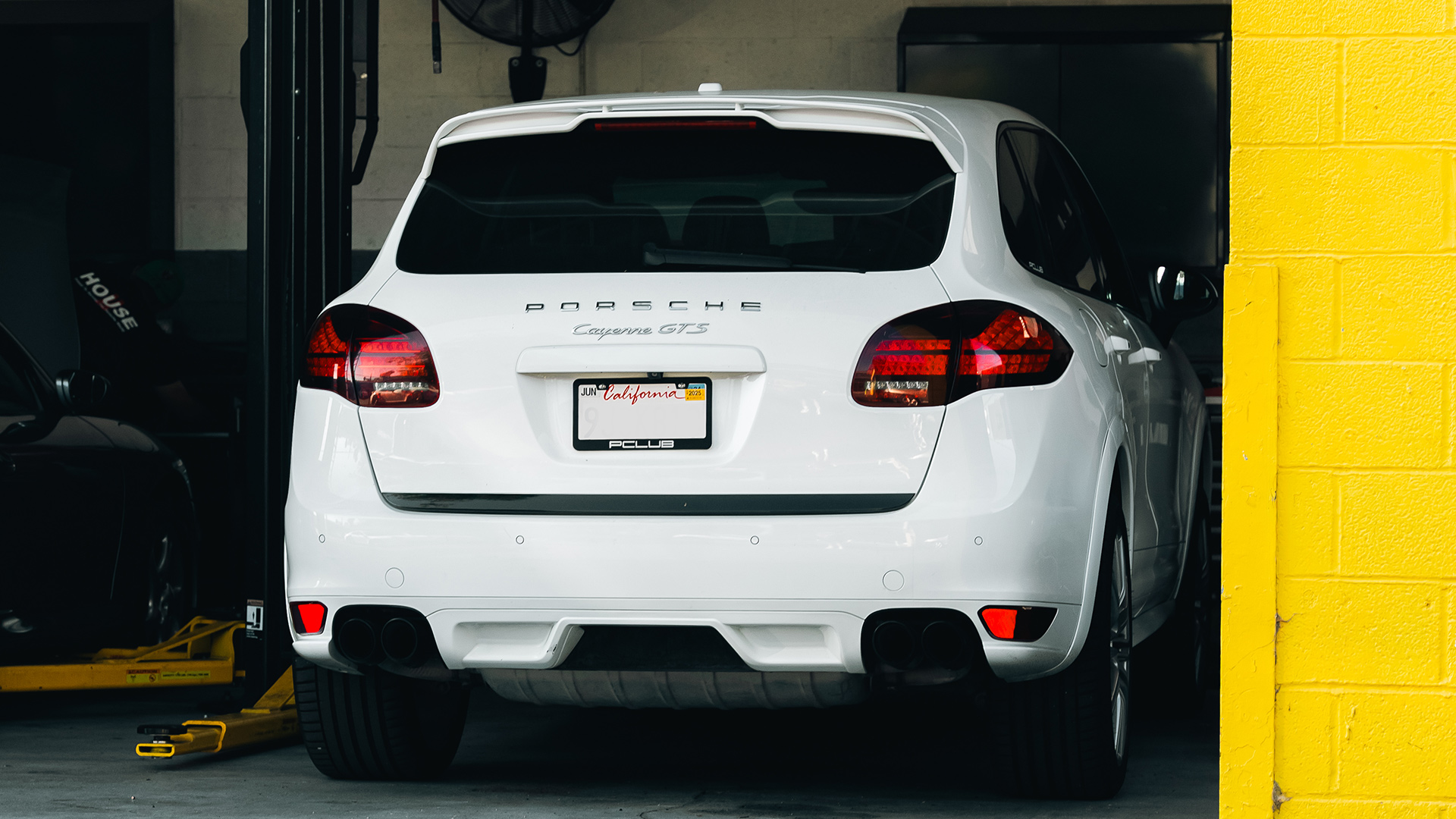
Third Generation: 9YA (2019–Present)
Service Schedule
| Service | Interval |
|---|---|
| Oil and filter change | Every 10,000 miles or 1 year |
| Brake fluid replacement | Every 2 years |
| Intermediate service | Every 20,000 miles or 2 years |
| Spark plug replacement (Turbo) | Every 30,000 miles or 4 years |
| Major service | Every 40,000 miles or 4 years |
| Air filter replacement | Every 40,000 miles or 4 years |
| Transfer case fluid | Every 20,000 miles — see note above |
| Differential fluid | Every 40,000 miles |
| Tire sealant check | Every 40,000 miles or at expiry |
For the 9YA, roof drain clearing is part of the standard annual visit. The panoramic roof and drainage channels on this generation can clog with debris, which causes water to enter the cabin. It’s a quick inspection item that prevents a genuinely expensive problem.
9YA E-Hybrid & Turbo GT Additions
The current generation brought full plug-in hybrid technology to the Cayenne lineup — E-Hybrid, Turbo S E-Hybrid, and for the Turbo GT, a high-output turbocharged V8 requiring its own attention. Key additions to the standard schedule:
| Additional Service | Interval |
|---|---|
| High-voltage battery system inspection | Every service visit — PIWIS required |
| HV cooling system check | Every 20,000 miles / 2 years |
| Brake fluid change + adaptation (E-Hybrid) | Every 40,000 miles / 4 years |
| Cabin air filter | Every 20,000 miles / 2 years |
| Turbo GT: oil change interval | Every 6,000 miles or 1 year |
Common Issues to Watch
PASM / air suspension faults. The 9YA’s air suspension is more robust than previous generations, but air strut leaks, compressor wear, and ride height sensor failures still develop — particularly on cars with higher mileage or those that have been used in demanding conditions. Symptoms are the same as earlier generations: a sagging corner after sitting overnight, “Chassis System Error” warnings, or uneven ride height across axles. Catch it early and you’re typically looking at a strut or sensor replacement. Let it run until the compressor is working continuously and the repair scope expands considerably.
Oil filter housing seal leaks (3.0L V6 engine). A proportion of 9YA Cayennes equipped with the base 3.0L turbocharged V6 develop oil leaks from the oil filter housing seal over time. The symptom is an oil smell from the engine bay and visible seepage around the housing. It’s a straightforward repair, but one that’s best addressed promptly before oil reaches hot exhaust components.
Electric coolant pump failure (Turbo). The 9YA Turbo’s 4.0L V8 uses an electric coolant pump. These pumps are a known wear item and represent one of the more common unscheduled repair items HOUSE technicians encounter on high-mileage 9YA Turbos. A proactive inspection of the cooling system at major service intervals is the sensible approach.
Infotainment and software stability (early 2019–2021). Early 9YA cars running original firmware had documented software instability — laggy PCM responses, freezing screens, and Bluetooth connectivity gaps. Most of these have been resolved through updates. If you own a 2019–2021 Cayenne and haven’t had a software update recently, a PIWIS session will confirm the current firmware status and apply any pending updates.
CV boot wear. CV boots on the 9YA degrade over time in the same way they do on every Porsche platform. A torn boot left unchecked allows dirt and moisture into the joint, which turns a simple boot replacement into a joint replacement. This is a standard inspection item at every intermediate service.
E-Hybrid & High-Voltage Battery Care
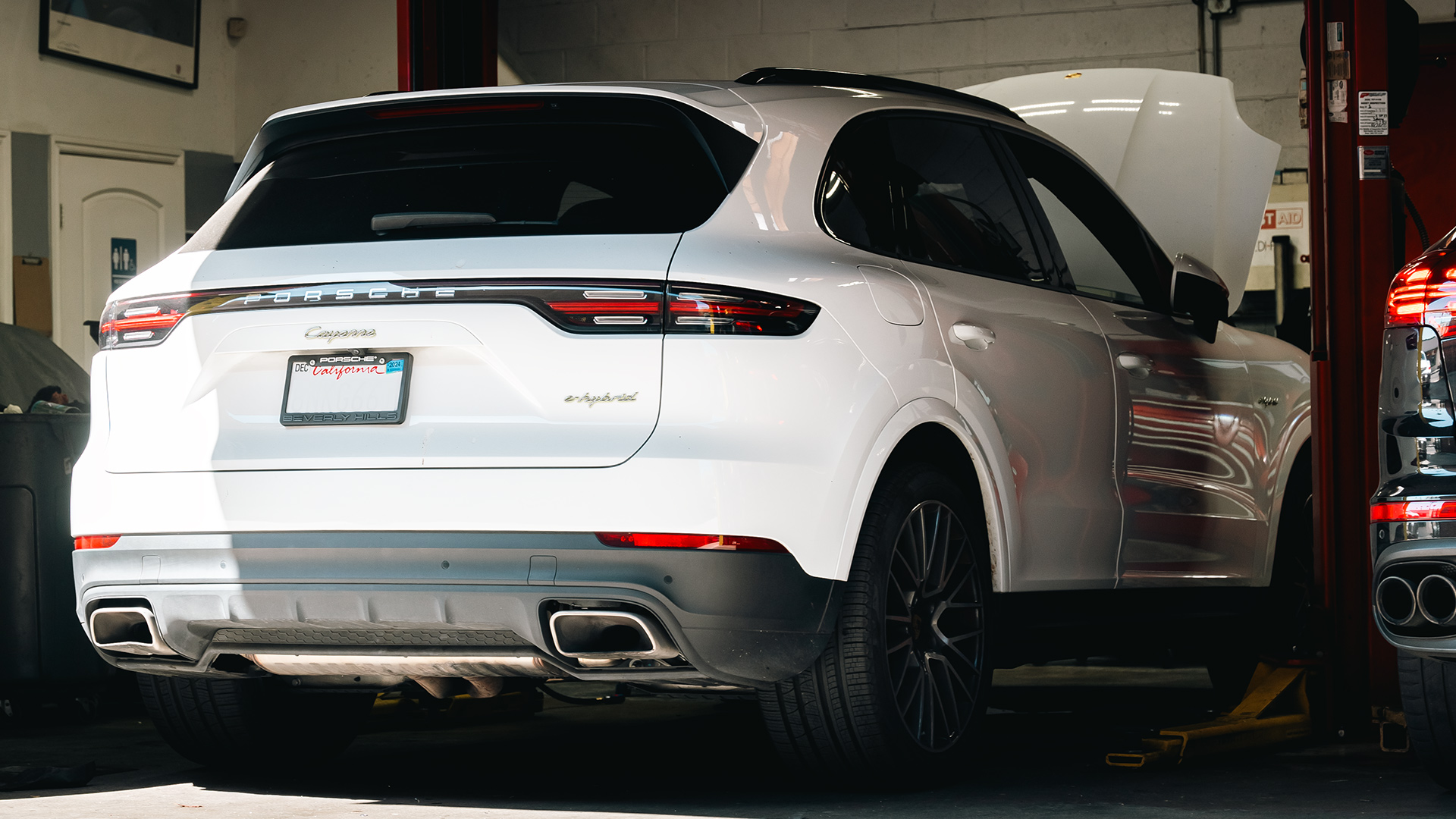
Every Cayenne E-Hybrid — from the 958.2 S E-Hybrid through the current 9YA Turbo S E-Hybrid — carries a high-voltage battery system that requires specific maintenance habits. The fundamentals apply across all generations:
Charge management. Keep the battery state of charge between 20% and 80% for day-to-day use. Regular full charges to 100% and regular full discharges both accelerate degradation over time. Porsche’s own guidance is to avoid consistent overnight charging to 100% unless you need the full range — charging to 80% and leaving it is kinder to the battery long-term.
Drive regularly. Extended inactivity degrades hybrid battery chemistry. If the car sits for extended periods, maintaining a partial charge state (40–60%) is better than leaving it fully charged or fully discharged. For long-term storage, a trickle charger on the 12V system handles the standard battery; the HV battery should be brought to a mid-state charge before storage.
Avoid sustained extreme heat. Southern California parking conditions — particularly during summer months — put thermal stress on the HV battery. Garage parking or shaded spots reduce the cumulative heat exposure that slowly erodes capacity over years.
PIWIS diagnostics for everything HV-related. High-voltage battery state-of-health evaluation, fault code reading for the hybrid management system, and the brake fluid adaptation procedure required on E-Hybrid models all require PIWIS-level diagnostics. HOUSE Automotive runs the same Porsche factory diagnostic system used at Porsche dealerships — it’s the only tool that reads the full depth of the E-Hybrid’s electrical architecture. A generic OBD scanner accesses perhaps 15% of what PIWIS sees on one of these cars.
Maintenance Practices That Apply to Every Cayenne
Regardless of generation, these habits have the most consistent impact on keeping a Cayenne running well and keeping the repair side of ownership as predictable as possible.
Stay on the annual oil service. The 10,000-mile or 1-year interval is not a suggestion. Porsches run tight tolerances and high-specification full synthetic oil. Degraded oil in a turbocharged engine accelerates wear on bearings and turbocharger components in ways that don’t announce themselves immediately. The damage accumulates quietly.
Do the brake fluid on schedule. Two years is the interval across all Cayenne generations, and it matters more on a 5,000+ lb SUV than on a 3,200 lb sports car. Brake fluid is hygroscopic — it absorbs moisture, which lowers its boiling point. On a heavy SUV driven at performance pace, degraded fluid increases fade risk meaningfully.
Service the transfer case fluid proactively. Given the documented transfer case wear patterns across all three generations, treat transfer case fluid as a routine consumable rather than a long-interval item. Pair it with the intermediate service at every 20,000 miles.
Inspect air suspension at every major service. Catching a developing air strut leak or relay issue before the compressor starts overworking saves a significant repair scope. Air suspension components are inspectable without specialized equipment — a visual check for ride height consistency and listening for compressor run time are both useful starting points.
Use OEM parts and the correct fluid specifications. The Cayenne’s turbocharged engines, PDK and Tiptronic transmissions, and E-Hybrid systems are calibrated to specific fluid specifications. Substituting off-spec fluids introduces variables these systems weren’t designed for. HOUSE Automotive uses genuine OEM Porsche parts and factory-specified fluids on every service. For a perspective on how OEM parts and independent pricing compare to dealer rates, the Porsche Maintenance Costs Guide has a full breakdown.
Porsche Cayenne Maintenance PDFs
- 2003-2006 9PA Cayenne Major Maintenance Checklist
- 2003-2006 955 Cayenne Minor Maintenance Checklist
- 2008 957 Cayenne Minor Maintenance Checklist
- 2008 957 Cayenne Major Maintenance Checklist
- 2008 957 Cayenne V6 Minor Maintenance Checklist
- 2008 957 Cayenne V6 Major Maintenance Checklist
- 2009 957 Cayenne Intermediate Maintenance Checklist
- 2009 957 Cayenne Maintenance Checklist
- 2010 958.1 Cayenne Intermediate Maintenance Checklist
- 2010 958.1 Cayenne Maintenance Checklist
- 2011-2012 958.1 Cayenne Intermediate Maintenance Checklist
- 2011-2012 958.1 Cayenne Maintenance Checklist
- 2013 958.1 Cayenne Intermediate Maintenance Checklist
- 2013 958.1 Cayenne Maintenance Checklist
- 2015-2018 958.2 Cayenne Intermediate Maintenance Checklist
- 2015-2018 958.2 Cayenne Maintenance Checklist
- 2019+ Cayenne Inspection Sheet
- 2019+ Cayenne Oil Service Checklist
Frequently Asked Questions
How often should a Porsche Cayenne be serviced?
All Cayenne generations use a 10,000-mile or 1-year oil service interval (whichever comes first). An intermediate service is due every 20,000 miles or 2 years, and a major service every 40,000 miles or 4 years. The exception is the Turbo GT, which follows a tighter 6,000-mile oil interval given its high-performance engine demands.
What are the most common Porsche Cayenne problems?
Transfer case wear (all generations, most pronounced on the 958), air suspension compressor failure (all generations with optional air suspension), coolant pipe failure on V8 models (955 and 958), and high-voltage battery degradation on E-Hybrid models. Each has a clear prevention story rooted in staying on the service schedule and using correct fluid specifications.
Is a Porsche Cayenne expensive to maintain?
The Cayenne sits in the mid-range of Porsche ownership costs. For annual maintenance costs by model and how independent shop pricing compares to the dealer, see the complete Porsche Maintenance Costs Guide.
How long does a Porsche Cayenne last?
With disciplined maintenance, Cayennes routinely reach 150,000 to 200,000 miles. The cars that accumulate repair histories are usually the ones that skipped service intervals, ran deferred fluid changes, or had generation-specific known issues left unaddressed. The car’s longevity tracks closely with how it was maintained, not just how many miles it has.
Is the Porsche Cayenne E-Hybrid expensive to maintain?
The E-Hybrid adds a handful of service items to the standard schedule — HV battery inspections, clutch brake fluid adaptation, and on the 958.2 S E-Hybrid, the supercharger drive belt replacement. The incremental cost over a standard Cayenne service is modest on routine visits. The larger variable is high-voltage battery condition on older E-Hybrid models, which requires a PIWIS evaluation to assess accurately.
Does taking my Cayenne to an independent shop affect my warranty?
No. Under the Magnuson-Moss Warranty Act, dealers cannot require owner-pay service to maintain factory warranty coverage, provided the work is performed correctly with appropriate parts and documentation. HOUSE Automotive documents every service to factory specification.
What is the most important preventive maintenance item on a 955 Cayenne?
Coolant pipe inspection and replacement on V8 models. The plastic coolant pipes beneath the intake manifold are a documented failure point on high-mileage 955 S and Turbo cars. Replacing them before they crack — and pairing the job with a water pump and thermostat replacement while the intake is off — is the single highest-leverage preventive item on that generation.
What should I watch for when buying a used 958 Cayenne?
Transfer case condition and coolant system status are the two priority items. A thorough pre-purchase inspection with PIWIS diagnostics will surface fault codes, evaluate transfer case function, and check air suspension operation — the three areas that generate the largest repair bills on this generation. Air suspension strut condition and E-Hybrid battery state (on S E-Hybrid models) are also worth evaluating specifically.
Service Your Cayenne at HOUSE Automotive
Three locations across Los Angeles: Encino, Pasadena, and Thousand Oaks — each staffed by independently certified Porsche technicians with 120+ years of combined Porsche experience. HOUSE Automotive uses Porsche’s PIWIS diagnostic system, genuine OEM parts, and follows factory service protocols on every Cayenne generation from the 955 through the current 9YA.
Every service is backed by a 2-year, unlimited-mile warranty on all parts and labor. HOUSE clients consistently save up to 30% compared to Porsche dealership pricing. Free shuttle service, free vehicle pickup and drop-off, and rental car arrangements available at all three locations.